Monday, November 25, 2024

Steam Generator

 A steam generator is a device used to produce steam by applying heat energy to water. Steam is widely used in industrial processes, power generation, heating systems, and more. Steam generators can range from small units used in applications like saunas to large industrial systems in power plants or refineries.


Types of Steam Generators

  1. Fire-Tube Boilers:

    • Heat passes through tubes surrounded by water.
    • Common in low- to medium-pressure applications.
    • Examples: Scotch marine boilers.
  2. Water-Tube Boilers:

    • Water flows through tubes heated externally by a flame or hot gases.
    • Suitable for high-pressure and high-temperature applications.
    • Examples: Utility boilers in power plants.
  3. Electric Steam Generators:

    • Use electric heating elements to produce steam.
    • Compact, clean, and commonly used in laboratories and small industries.
  4. Once-Through Boilers:

    • Water flows continuously without a drum, directly converting to steam.
    • Compact and highly efficient.
  5. Nuclear Steam Generators:

    • Used in nuclear power plants to transfer heat from the reactor to produce steam for turbines.

Key Components

  1. Feedwater System:

    • Supplies water to the generator.
    • Includes pumps, preheaters, and deaerators to remove oxygen and other gases.
  2. Furnace/Burner:

    • Generates heat using fuels like natural gas, oil, or coal.
    • Electric generators use heating coils.
  3. Heat Exchanger/Coils:

    • Transfers heat to water to produce steam.
  4. Steam Drum (in water-tube boilers):

    • Separates steam from water in multi-drum designs.
  5. Control Systems:

    • Maintain pressure, temperature, and water levels.

Applications

  1. Power Generation:

    • Produces high-pressure steam to drive turbines in thermal or nuclear power plants.
  2. Process Industries:

    • Used in chemical plants, refineries, and food processing for sterilization, drying, or heating.
  3. HVAC and Building Systems:

    • Centralized steam systems for heating large buildings or districts.
  4. Marine Applications:

    • Provides steam for propulsion and auxiliary systems on ships.

Working Principle

  1. Heat Input:

    • The heat source raises the temperature of the water.
  2. Phase Change:

    • Water absorbs heat and turns into steam at its boiling point.
  3. Steam Collection:

    • The generated steam is collected and directed for use.

Advantages

  • High energy transfer efficiency.
  • Versatile applications across industries.
  • Scalable from small to very large systems.

Challenges

  • Requires careful maintenance to avoid scaling and corrosion.
  • High-pressure systems need rigorous safety protocols.
  • Initial costs can be high for large-scale systems.

1-Fire Tube Boiler

Fire-tube boilers are one of the oldest and simplest types of steam boilers, commonly used for low- to medium-pressure steam applications. In a fire-tube boiler, hot gases produced from fuel combustion flow through tubes, which are surrounded by water. The heat from the gases transfers through the tube walls to the water, converting it into steam.


Key Features of Fire-Tube Boilers

  1. Design Simplicity:

    • Compact and easy to install.
    • Low initial cost compared to other boiler types.
  2. Applications:

    • Ideal for low- and medium-pressure applications (up to ~250 psi).
    • Used in heating systems, small power plants, and process industries.
  3. Fuel Types:

    • Can use a variety of fuels, including natural gas, oil, coal, or biomass.

Components of a Fire-Tube Boiler

  1. Shell:

    • The outer cylindrical vessel containing water and the fire tubes.
  2. Fire Tubes:

    • Tubes running through the boiler where hot gases flow.
    • Heat is transferred from the gases to the surrounding water.
  3. Furnace or Combustion Chamber:

    • Located at one end of the boiler.
    • Fuel is burned to generate hot gases.
  4. Burner:

    • Supplies and mixes air and fuel for efficient combustion.
  5. Steam Space:

    • Located at the top of the shell where steam collects before being sent to the outlet.
  6. Chimney/Stack:

    • Exhausts combustion gases to the atmosphere.
  7. Water Level Controls:

    • Maintain proper water levels to prevent damage to the tubes or overheating.
  8. Safety Valves:

    • Release excess pressure to prevent explosions.

How Fire-Tube Boilers Work

  1. Fuel Combustion:

    • Fuel is burned in the furnace, creating hot gases.
  2. Heat Transfer:

    • The hot gases flow through the fire tubes, transferring heat to the surrounding water.
  3. Steam Generation:

    • As water absorbs heat, it turns into steam.
    • Steam collects in the steam space for delivery to the application.
  4. Exhaust:

    • After transferring heat, gases exit through the stack.

Advantages of Fire-Tube Boilers

  1. Simple Design:
    • Easy to operate and maintain.
  2. Cost-Effective:
    • Lower initial and operational costs for small-scale applications.
  3. Durable:
    • With proper maintenance, these boilers can last for decades.
  4. Reliable:
    • Proven technology with widespread use.

Limitations of Fire-Tube Boilers

  1. Limited Pressure and Capacity:
    • Not suitable for high-pressure or high-capacity applications.
  2. Long Startup Time:
    • Slower response to load changes compared to water-tube boilers.
  3. Risk of Explosion:
    • Water inside the shell stores significant energy, which can be dangerous if safety systems fail.
  4. Efficiency:
    • Generally lower thermal efficiency than water-tube boilers.

Common Types of Fire-Tube Boilers

  1. Scotch Marine Boiler:
    • Widely used in ships and industrial applications.
  2. Horizontal Return Tubular Boiler:
    • Simple design with horizontal tubes.
  3. Vertical Fire-Tube Boiler:
    • Compact, suitable for small-scale applications like steam engines.
  4. Lancashire Boiler:
    • Features two large fire tubes for better heat distribution.

Applications of Fire-Tube Boilers

  • Heating buildings (space heating).
  • Steam supply for small industrial processes.
  • Hot water heating in commercial and residential buildings.
  • Marine applications (e.g., powering steam-driven ships).

Water-Tube Boilers

Water-tube boilers are high-performance steam-generating units designed for industrial and power-generation applications. Unlike fire-tube boilers, in a water-tube boiler, water flows through tubes heated externally by hot gases. This design allows them to operate at higher pressures and temperatures, making them ideal for large-scale steam production.


Key Features of Water-Tube Boilers

  1. High Pressure and Temperature:

    • Operate at pressures up to 3,000 psi or more and temperatures exceeding 550°C.
  2. Compact and Efficient:

    • Compact design with better heat transfer efficiency due to a higher surface-area-to-volume ratio.
  3. Rapid Steam Generation:

    • Produces steam quickly, ideal for power plants and industrial processes with variable demands.

Components of a Water-Tube Boiler

  1. Drums:

    • Steam Drum:
      • Located at the top, it separates steam from water.
    • Mud Drum:
      • Found at the bottom, collects sediment and impurities.
  2. Water Tubes:

    • Water flows through these tubes, which are exposed to heat from the combustion gases.
  3. Furnace or Combustion Chamber:

    • Houses the burner for fuel combustion and heat generation.
  4. Burner:

    • Provides a controlled supply of fuel and air for combustion.
  5. Superheater:

    • Enhances steam quality by heating saturated steam to make it superheated.
  6. Economizer:

    • Preheats feedwater using exhaust gases to improve efficiency.
  7. Air Preheater:

    • Heats combustion air with exhaust gases, further enhancing boiler efficiency.
  8. Control Systems:

    • Maintain water levels, pressure, and temperature.

How Water-Tube Boilers Work

  1. Water Circulation:

    • Feedwater enters the economizer and flows into the steam drum.
    • Water is distributed to the water tubes and flows downward into the mud drum.
  2. Heat Transfer:

    • Heat from the combustion gases transfers to the water in the tubes, converting it to steam.
  3. Steam Separation:

    • The steam drum separates the steam from water.
    • Steam is sent to the superheater (if present) for further heating.
  4. Exhaust:

    • Hot gases exit through the economizer and air preheater before being vented via the stack.

Advantages of Water-Tube Boilers

  1. High Pressure and Capacity:

    • Suitable for large-scale industrial and power-generation applications.
  2. Fast Response:

    • Quickly meets changes in steam demand.
  3. Compact Design:

    • Saves space in high-capacity plants.
  4. Increased Safety:

    • Stores less water, reducing the risk of explosion compared to fire-tube boilers.
  5. Higher Efficiency:

    • Economizer and preheater maximize fuel usage.

Limitations of Water-Tube Boilers

  1. Complex Design:
    • Requires skilled operation and maintenance.
  2. Higher Initial Cost:
    • More expensive to purchase and install than fire-tube boilers.
  3. Maintenance Intensive:
    • Tubes are more prone to fouling and require frequent cleaning.
  4. Sensitive to Water Quality:
    • Requires high-quality feedwater to prevent scaling and corrosion.

Applications of Water-Tube Boilers

  1. Power Plants:

    • Produces steam to drive turbines for electricity generation.
  2. Industrial Processes:

    • Used in chemical plants, refineries, and pulp and paper industries.
  3. Marine Industry:

    • Provides steam for propulsion and auxiliary systems on ships.
  4. Food and Beverage Industry:

    • Sterilization, cooking, and drying processes.

Types of Water-Tube Boilers

  1. Babcock and Wilcox Boiler:

    • Horizontal water tubes and an external furnace.
  2. La-Mont Boiler:

    • Forced circulation system for high efficiency.
  3. Benson Boiler:

    • Supercritical boiler without a steam drum, operating at pressures above the critical point.
  4. Stirling Boiler:

    • Multi-drum boiler with excellent load flexibility.
  5. D-Type Boiler:

    • Compact design, widely used in marine and industrial applications.

Electric Steam Generators

Electric steam generators are compact and efficient devices that produce steam using electricity as the heat source. These units are commonly used in industries and applications where clean, efficient, and precise steam generation is needed, such as in laboratories, food processing, and pharmaceutical production.


Key Features of Electric Steam Generators

  1. Electric Heating:

    • Use electric resistance elements or electrodes to heat water directly.
    • No combustion of fuel, making them environmentally friendly.
  2. Compact Design:

    • Small footprint compared to traditional boilers.
    • Ideal for locations with limited space.
  3. Clean Operation:

    • No emissions, making them suitable for sensitive applications like sterilization.
  4. Ease of Use:

    • Simple controls for quick startup and shutdown.

Components of an Electric Steam Generator

  1. Water Reservoir:

    • Stores the feedwater required for steam generation.
  2. Heating Elements:

    • Electric coils or electrodes immersed in water for efficient heat transfer.
  3. Steam Outlet:

    • Releases generated steam to the application or process.
  4. Control System:

    • Monitors temperature, pressure, and water levels.
    • Automatic shutoff in case of abnormal conditions.
  5. Safety Devices:

    • Pressure relief valves and thermal cutoffs to prevent overpressure or overheating.
  6. Insulated Housing:

    • Reduces heat loss and improves efficiency.

How Electric Steam Generators Work

  1. Water Supply:

    • Feedwater is pumped into the generator's reservoir or directly into the heating chamber.
  2. Electric Heating:

    • Electric elements heat the water, converting it into steam.
  3. Steam Production:

    • Steam is collected in the chamber and released through the outlet for use.
  4. Safety and Control:

    • Sensors maintain pressure and temperature within preset limits.

Advantages of Electric Steam Generators

  1. Environmentally Friendly:

    • No emissions or combustion byproducts.
  2. Energy Efficiency:

    • High efficiency due to direct conversion of electricity into heat.
  3. Low Maintenance:

    • Fewer moving parts compared to fuel-fired boilers.
  4. Compact and Quiet:

    • Minimal space requirements and quiet operation.
  5. Precise Control:

    • Accurate regulation of steam output for specialized applications.
  6. No Fuel Storage:

    • Eliminates the need for on-site fuel storage, reducing hazards.

Limitations of Electric Steam Generators

  1. High Operating Costs:
    • Electricity can be more expensive than other fuels like natural gas.
  2. Capacity Limitations:
    • Typically used for low- to medium-capacity applications (up to ~200 kW).
  3. Power Supply Dependency:
    • Requires a reliable and sufficient electrical supply.

Applications of Electric Steam Generators

  1. Healthcare and Laboratories:

    • Autoclaves, sterilization, and humidification.
  2. Food and Beverage Industry:

    • Cooking, cleaning, and sterilizing equipment.
  3. Pharmaceutical Production:

    • Steam for manufacturing and sterilization processes.
  4. Textile Industry:

    • Steam for pressing and finishing fabrics.
  5. Industrial Processes:

    • Small-scale steam applications in chemical and manufacturing industries.
  6. Hospitality:

    • Steam saunas, spas, and laundry facilities.

Types of Electric Steam Generators

  1. Resistance Heating Generators:

    • Use electric coils to heat water.
    • Common in low-capacity systems.
  2. Electrode Boilers:

    • Water acts as a conductor, and electrodes generate heat by passing current through it.
    • Suitable for higher capacities.


Multi-column distillation unit

 A multi-column distillation unit is a specialized process system used in industries such as petroleum refining, chemical manufacturing, and water purification to separate components of a mixture based on differences in their boiling points. The unit operates with multiple distillation columns arranged in a series or parallel, allowing for more precise and efficient separation of mixtures.

Key Components:

  1. Distillation Columns:

    • The primary structures where the separation occurs.
    • Typically packed or tray columns to enhance contact between vapor and liquid phases.
  2. Reboiler:

    • Provides the necessary heat to vaporize the liquid at the column's bottom.
  3. Condenser:

    • Cools and condenses the overhead vapor to collect the desired distillate.
  4. Feed Preheater:

    • Prepares the feed mixture by raising its temperature close to the boiling range.
  5. Interconnecting Piping:

    • Transfers intermediate streams from one column to another.
  6. Control Systems:

    • Automation for monitoring temperature, pressure, and flow rates.
  7. Pumps and Compressors:

    • For moving liquids and gases between columns.

Types of Multi-Column Distillation Units:

  1. Petroleum Fractionation Units:

    • Used in refineries to separate crude oil into fractions like gasoline, kerosene, and diesel.
  2. Azeotropic and Extractive Distillation:

    • Removes components with similar boiling points using specific agents or solvents.
  3. Cryogenic Air Separation Units:

    • Separates gases like oxygen, nitrogen, and argon at very low temperatures.
  4. Multistage Water Distillation:

    • Common in desalination plants for producing potable water.

Working Principle:

  1. Feed Entry:
    • The mixture enters the first column where the most volatile components are separated.
  2. Vapor-Liquid Interaction:
    • Vapor rises, and liquid flows down, promoting heat and mass transfer.
  3. Intermediate Processing:
    • Intermediate streams are sent to subsequent columns for further purification.
  4. Product Recovery:
    • Each column yields a specific product fraction.

Advantages:

  • High separation efficiency for complex mixtures.
  • Scalability for industrial needs.
  • Reduced energy consumption when optimized.

Challenges:

  • High capital and operational costs.
  • Complex design and control requirements.
  • Risk of fouling and corrosion.

An example of a multi-column distillation unit is the Crude Oil Distillation Unit (CDU) in petroleum refineries, which separates crude oil into different fractions. Here's how it works:


Example: Crude Oil Distillation Unit (CDU)

  1. Feed Preheating:

    • Crude oil is preheated using heat exchangers and then sent to a desalter to remove salts and impurities.
    • It is further heated in a furnace to reach temperatures of around 350–400°C.
  2. Primary Distillation (Atmospheric Column):

    • The heated crude enters the atmospheric distillation column.
    • Separation of lighter fractions occurs:
      • Overhead Products: Gas, naphtha (used for gasoline production).
      • Side Draws: Kerosene, diesel.
      • Bottoms Product: Residual oil (sent to further processing in vacuum distillation).
  3. Secondary Distillation (Vacuum Column):

    • The heavy residue from the atmospheric column is sent to a vacuum distillation column.
    • Operates under reduced pressure to separate components without cracking them.
      • Products: Light vacuum gas oil (used for lube oils) and vacuum residue (used for asphalt or as feedstock for coking units).
  4. Side Processing Units:

    • Depropanizer Column: Separates propane and butanes from naphtha.
    • Debutanizer Column: Further refines the naphtha fraction.
    • Reformers: Upgrade lighter fractions into high-octane gasoline components.

Process Overview

ColumnFeedOutput
Atmospheric ColumnPreheated Crude OilGases, Naphtha, Kerosene, Diesel, Atmospheric Residue
Vacuum ColumnAtmospheric ResidueVacuum Gas Oil, Vacuum Residue
Side ColumnsIntermediate StreamsLPG, Purified Gasoline, etc.

Benefits of Multi-Column Approach in CDU:

  • Maximizes crude oil utilization by separating components efficiently.
  • Allows integration of additional processing units for enhanced product value.
  • Reduces energy consumption by reusing heat between columns (heat integration).

What is Civil Engineering?

 Civil engineering is a professional discipline that focuses on the design, construction, and maintenance of infrastructure and the built environment. It plays a pivotal role in shaping the world around us by creating the systems and structures necessary for modern society to function effectively.


Key Areas of Civil Engineering

Civil engineering covers a broad range of sub-disciplines, including:

  1. Structural Engineering
    Focuses on designing and analyzing structures like buildings, bridges, and tunnels to ensure they can withstand loads and stresses.

  2. Geotechnical Engineering
    Deals with the behavior of earth materials, ensuring foundations and earthworks are stable and safe.

  3. Transportation Engineering
    Plans and designs transportation systems, including highways, railways, airports, and traffic management systems.

  4. Water Resources Engineering
    Focuses on managing water systems, including dams, canals, drainage systems, and flood control measures.

  5. Environmental Engineering
    Concentrates on creating sustainable solutions to reduce pollution, manage waste, and protect natural resources.

  6. Construction Management
    Oversees project planning, execution, and cost control to ensure timely and budget-friendly delivery of infrastructure projects.


What Do Civil Engineers Do?

Civil engineers are responsible for:

  • Planning: Conducting site surveys, feasibility studies, and environmental assessments.
  • Designing: Using software like AutoCAD or Revit to create plans for structures and systems.
  • Building: Overseeing construction, ensuring compliance with safety and quality standards.
  • Maintaining: Monitoring infrastructure for wear and tear and implementing necessary repairs.

Importance of Civil Engineering

Civil engineering is essential for:

  • Public Safety: Ensuring structures like buildings and bridges are safe to use.
  • Economic Growth: Developing infrastructure to support industries and transportation.
  • Sustainability: Promoting eco-friendly designs and renewable energy solutions.
  • Urbanization: Creating smart cities and sustainable housing for growing populations.

Examples of Civil Engineering Achievements

  • The Eiffel Tower (Paris, France) – An iconic structural design.
  • The Hoover Dam (USA) – A marvel of water resources engineering.
  • The Channel Tunnel (UK-France) – A feat of geotechnical and structural expertise.

How to Optimize Structural Designs Using Finite Element Analysis (FEA)

Introduction

Structural engineering is a cornerstone of modern construction, and precision in design is non-negotiable. Finite Element Analysis (FEA) has become a go-to tool for engineers, enabling them to simulate and optimize complex structures before construction even begins. In this post, we’ll explore the basics of FEA, how it benefits structural design, and tips for getting the best results.


What is Finite Element Analysis (FEA)?
Finite Element Analysis is a computational technique used to predict how a structure will behave under various conditions. By breaking a structure into smaller elements (finite elements), engineers can analyze the stress, strain, and deformation under loads like wind, seismic activity, and weight.

For example:

  • In Bridges: FEA helps calculate load-bearing capacity and detect weak points.
  • In Skyscrapers: It evaluates wind resistance and stability.

Benefits of Using FEA in Structural Design

  1. Improved Accuracy
    FEA provides precise predictions by simulating real-world conditions. Engineers can anticipate issues early and avoid costly changes during construction.

  2. Material Optimization
    By understanding stress distribution, you can use materials more efficiently, reducing costs and environmental impact.

  3. Time Efficiency
    With FEA software, what used to take weeks in manual calculations can now be completed in hours.


Steps to Perform an FEA Analysis

  1. Model Your Structure
    Create a detailed 3D model using CAD software. Define the geometry and ensure it’s accurate.

  2. Set Material Properties
    Assign material properties such as Young’s Modulus, density, and Poisson’s ratio.

  3. Apply Boundary Conditions and Loads
    Specify supports, constraints, and external loads (e.g., weight, wind pressure).

  4. Mesh the Model
    Divide the structure into finite elements. A finer mesh usually means higher accuracy but takes more computational power.

  5. Run the Simulation
    Use software like ANSYS, Abaqus, or SolidWorks Simulation to analyze the model.

  6. Interpret Results
    Review stress, strain, and displacement plots to identify weak points and make necessary design changes.


Pro Tips for Effective FEA

  • Start Simple: Begin with a basic model and refine as needed. Complex models can be overwhelming without proper planning.
  • Validate Your Results: Cross-check with hand calculations or test results.
  • Understand Software Limitations: Every FEA tool has its constraints; use them wisely.

Case Study: Redesigning a Steel Footbridge with FEA
In a recent project, engineers used FEA to optimize a steel footbridge design. Initial calculations showed excessive stress at the joints. By tweaking the design and redistributing the load-bearing elements using FEA, the team reduced material usage by 15% and ensured safety under expected traffic loads.


Conclusion
Finite Element Analysis is a game-changer for structural engineers. It not only improves precision but also saves time and resources. As software becomes more advanced, mastering FEA can give you a significant edge in your projects.

What challenges have you faced when using FEA? Share your experiences in the comments below!

Method Statement for Excavation and Backfilling

The purpose of this method statement is to outline the procedures and controls to be implemented for excavation and backfilling activities to ensure they are conducted safely and in accordance with project specifications and regulatory requirements.


Tuesday, March 21, 2023

Rectangular

In engineering and construction, rectangular refers to a shape that has four sides and four right angles, with opposite sides being parallel and equal in length. The shape is defined by its length, width, and height (if it is a three-dimensional object). Rectangles are used extensively in construction and engineering to represent various elements such as walls, slabs, beams, and columns. Some common uses of rectangles in engineering and construction include: Floor plans and elevations: Rectangles are used to represent rooms, walls, and other architectural elements in building plans and elevations. Concrete slabs: Rectangular shapes are commonly used for concrete slabs such as foundations, floors, and walls. Beams and columns: Rectangular sections are used to create beams and columns in construction. Ductwork and piping: Rectangular ductwork and piping are often used for ventilation, air conditioning, and plumbing systems. Electrical panels and junction boxes: Rectangular shapes are commonly used for electrical panels and junction boxes in buildings. The use of rectangular shapes in engineering and construction allows for precise and efficient design and construction. The properties of rectangles, such as their uniformity and symmetry, make them an important tool in the creation of various structures and infrastructure.

Circle

In the context of engineering or construction, a circle is a two-dimensional geometric shape that is defined as a set of points that are equidistant from a fixed point called the center. The distance between the center and any point on the circle is called the radius, and the distance across the circle, passing through the center, is called the diameter. Circles are used in engineering and construction in a variety of ways, including: To represent circular objects such as pipes, tanks, and columns. To define curves in roads, bridges, and other infrastructure. To create arcs and angles for precise measurements and construction. To create patterns and decorative elements in architecture and design. Circles are often used in combination with other geometric shapes such as squares and triangles to create complex designs and structures. The properties of circles, such as their symmetry and uniformity, make them an important tool in the design and construction of various engineering and architectural projects.

Line & Line Types

In the context of engineering or construction, a line refers to a continuous and uninterrupted path or mark that has length but no width or depth. Lines are used extensively in engineering and construction to represent various elements such as boundaries, edges, and axis of an object or structure. Some common types of lines used in engineering and construction include: Solid lines: Used to represent visible edges or boundaries of an object or structure. Dashed lines: Used to represent hidden edges or boundaries of an object or structure. Center lines: Used to represent the center of a circular or symmetrical object or structure. Construction lines: Used to represent temporary reference lines for alignment or positioning during the design process. Dimension lines: Used to indicate the length, width, and height of an object or structure. Leader lines: Used to connect a note or label to an object or structure. Using lines effectively is essential for accurate and clear engineering and construction drawings. It allows designers and builders to communicate their ideas and plans effectively and ensure that the final product meets the required specifications.

Basic of Engineering Design Electrical

Engineering design of electrical systems involves the creation of plans, diagrams, and models for electrical systems that are safe, efficient, and effective in meeting the requirements of the project. The process typically involves the following steps: Define the requirements: The first step is to define the requirements of the project, including the purpose of the electrical system, the load requirements, the power source, and the budget. Conduct a feasibility study: This step involves evaluating the technical and economic feasibility of the project. This includes considering factors such as the availability of materials and equipment, regulatory requirements, and the environmental impact of the project. Develop a conceptual design: In this step, the engineer develops a preliminary design of the electrical system, including the layout and the components that will be used. Create a detailed design: Based on the conceptual design, the engineer creates a detailed design of the electrical system. This includes creating detailed plans, diagrams, and models of the system and specifying the components and materials that will be used. Construct and test the system: Once the design is complete, the system can be constructed and tested to ensure that it meets the requirements of the project. Maintain the system: Finally, the engineer will develop a maintenance plan for the electrical system, including regular inspections and repairs to ensure that the system continues to function effectively over time. Throughout the design process, the engineer will need to consider factors such as safety, reliability, efficiency, and cost-effectiveness. They may also need to work closely with other professionals, such as architects, contractors, and regulatory agencies, to ensure that the electrical system meets all necessary requirements.

Basic of Engineering Design Civil

Civil engineering design involves the application of scientific and engineering principles to the design, construction, and maintenance of infrastructure and public works, such as buildings, roads, bridges, airports, and water supply and treatment systems. The primary objective of civil engineering design is to create structures and systems that are safe, durable, functional, and sustainable. Here are some of the basic principles and considerations that are important in civil engineering design: Site analysis and evaluation: This involves assessing the physical and environmental characteristics of the site, including topography, geology, hydrology, and ecology, to determine the feasibility and constraints of the proposed project. Design criteria and standards: Civil engineers must adhere to established design criteria and standards, such as building codes, zoning regulations, and industry-specific guidelines, to ensure that the structure or system meets the required performance, safety, and environmental standards. Materials selection: Civil engineers must select appropriate materials, such as concrete, steel, wood, or composite materials, based on the project requirements and site conditions, as well as factors such as cost, durability, and sustainability. Structural analysis and design: This involves the use of mathematical models and computer simulations to analyze the behavior of structures and systems under different loads and conditions, and to design structures that can withstand those loads and conditions. Construction management: Civil engineers must oversee the construction process to ensure that the structure or system is built according to the design specifications and standards, and that it is completed on time and within budget. Maintenance and operation: Civil engineers must also consider the long-term maintenance and operation of the structure or system, and design it in a way that allows for easy maintenance and repair, and minimizes the environmental impact. Overall, civil engineering design is a complex and multifaceted process that requires a deep understanding of scientific and engineering principles, as well as the ability to balance technical, economic, and environmental factors to create structures and systems that meet the needs of society.

Basic of Engineering Design Mechanical

Mechanical engineering design is a process of creating new products, systems, or devices that meet specific functional requirements. The following are some basic steps in the engineering design process for mechanical design: Define the problem: The first step in mechanical engineering design is to identify the problem that needs to be solved or the need that needs to be fulfilled. This step involves defining the problem statement, identifying design objectives, and specifying constraints. Gather information: Once the problem is defined, the next step is to gather information about the problem. This includes researching existing solutions, conducting surveys, analyzing data, and identifying user needs. Generate ideas: After gathering information, the next step is to generate ideas for possible solutions. Brainstorming, mind mapping, and other ideation techniques can be used to generate a wide range of potential solutions. Evaluate ideas: After generating ideas, the next step is to evaluate and compare them based on various criteria, such as feasibility, cost, performance, and usability. Develop a prototype: Once a promising idea is identified, the next step is to develop a prototype. This involves creating a physical or digital model of the product or system, testing it, and refining it based on feedback. Test and refine: Once a prototype is developed, it needs to be tested to ensure that it meets the design objectives and user needs. Based on the test results, the design may need to be refined and iterated until it meets the requirements. Produce the final design: Once the design is refined and finalized, the next step is to produce the final design. This involves creating detailed drawings, specifications, and instructions for manufacturing, assembly, and maintenance. Implement and maintain: The final step in mechanical engineering design is to implement the design and maintain it over time. This includes manufacturing, assembling, and testing the product or system, as well as providing ongoing support and maintenance

Thursday, March 2, 2023

Hydraulic Conveyor

A hydraulic conveyor is a fabric coping with machine that makes use of hydraulic strength to transport substances from one region to another. It consists of several key components, including: Hydraulic pump: This component is responsible for converting mechanical energy into hydraulic energy. It creates a flow of hydraulic fluid that powers the conveyor system. Hydraulic motor: This component converts hydraulic energy back into mechanical energy. It is responsible for driving the conveyor belt or other material handling equipment. Conveyor belt: This is the moving surface that carries materials from one point to another. It can be made of various materials, such as rubber, PVC, or steel, depending on the application. Control valves: These components regulate the flow and pressure of hydraulic fluid, which controls the speed and direction of the conveyor system. Hydraulic cylinders: These components are used to control the position and movement of various parts of the conveyor system, such as the conveyor belt tensioning system. The operation of a hydraulic conveyor involves pumping hydraulic fluid from a reservoir through a network of hoses and control valves to a hydraulic motor. The hydraulic motor then drives the conveyor belt or other material handling equipment, moving materials from one place to another. The speed and direction of the conveyor system are controlled by adjusting the flow and pressure of hydraulic fluid through the control valves. Hydraulic conveyors are commonly used in various industrial applications, such as mining, construction, and manufacturing, where heavy materials need to be moved over long distances. They are preferred over other types of conveyors because of their high efficiency, durability, and ability to handle heavy loads. However, they require regular maintenance and monitoring to ensure their safe and efficient operation. Produce the final design: Once the design is refined and finalized, the next step is to produce the final design. This involves creating detailed drawings, specifications, and instructions for manufacturing, assembly, and maintenance. Implement and maintain: The final step in mechanical engineering design is to implement the design and maintain it over time. This includes manufacturing, assembling, and testing the product or system, as well as providing ongoing support and maintenance

Screw Conveyor

A screw conveyor is a mechanical material handling system that is used to transport bulk materials from one place to another. It consists of a rotating screw inside a tube or trough that moves materials along the length of the conveyor. The screw is typically made of metal or other materials and can be designed in various shapes and sizes depending on the application. The basic components of a screw conveyor include: Screw: This is the main component of the conveyor and is responsible for moving the materials along the length of the conveyor. The screw can be designed with various shapes, such as helical or paddle, depending on the type of material being transported. Trough or tube: This is the enclosure that contains the screw and the materials being transported. It is typically made of metal or other materials that are resistant to wear and tear. Drive unit: This is the motor or other power source that drives the screw and moves the materials along the conveyor. Support structure: This is the frame or other support system that holds the conveyor in place and provides stability. The operation of a screw conveyor involves rotating the screw inside the tube or trough, which moves the materials along the length of the conveyor. The materials are fed into the conveyor at one end and discharged at the other end, typically into a storage container or another material handling system. Screw conveyors are commonly used in various industries, such as agriculture, mining, food processing, and construction, for transporting materials such as grain, sand, chemicals, and other bulk materials. They are preferred over other types of conveyors because they are versatile, efficient, and can handle a wide range of materials. However, they require regular maintenance and monitoring to ensure their safe and efficient operation.

Monday, February 27, 2023

Piping Work

Piping work refers to the installation and maintenance of piping systems used for the transport of fluids, such as liquids and gases, in industrial and commercial settings. These systems are used in a variety of applications, including heating and cooling, water supply, waste disposal, chemical processing, and power generation. The basic components of a piping system include pipes, fittings, valves, and pumps. The pipes are the main component and are used to transport fluids from one location to another. The fittings are used to connect the pipes and change the direction of the flow. Valves are used to control the flow of the fluid, and pumps are used to move the fluid through the system. The installation of a piping system involves several steps, including: Planning and design: This involves identifying the requirements of the system and determining the optimal layout, pipe sizing, and material selection. Pipe cutting and fitting: This involves cutting the pipes to the required length and connecting them using fittings, such as elbows, tees, and couplings. Welding or brazing: This is used to join the pipes and fittings together, creating a leak-proof seal. Valve and pump installation: Valves and pumps are installed in strategic locations to control the flow of fluid through the system. Testing and commissioning: This involves testing the system to ensure that it is functioning correctly and commissioning it for use. Maintenance of piping systems involves regular inspections, cleaning, and repairs to ensure that the system is functioning correctly and efficiently. Regular maintenance can help prevent leaks, corrosion, and other issues that can lead to system failure. Piping work requires specialized skills and knowledge, including an understanding of the properties of the fluids being transported, the materials used in the piping system, and the safety requirements of the installation and maintenance process. It is typically performed by trained professionals, such as plumbers, pipefitters, and industrial technicians. Types of Piping Works There are several types of piping works based on their purpose and application. Here are some common types: Process piping: This type of piping is used to transport fluids in industrial processes such as chemical, pharmaceutical, oil and gas, food processing, and water treatment plants. Plumbing piping: This type of piping is used to distribute and remove water and wastewater in residential and commercial buildings. HVAC piping: This type of piping is used in heating, ventilation, and air conditioning systems to distribute heated or cooled air throughout a building. Fire protection piping: This type of piping is used to provide water for fire sprinklers and standpipes in buildings and other structures. Gas piping: This type of piping is used to transport natural gas and other gases for industrial, commercial, and residential use. Steam piping: This type of piping is used to transport steam in industrial processes, heating systems, and power generation plants. Refrigeration piping: This type of piping is used to transport refrigerants in cooling systems for refrigeration and air conditioning. Each type of piping work requires different materials, installation techniques, and safety measures. For example, gas piping requires special materials and installation procedures to ensure safety, while steam piping requires materials that can withstand high temperatures and pressure. Therefore, it is important to select the right type of piping work and hire professionals with experience and knowledge in the specific type of piping work required.

Cerafiltec

1 Introduction Congratulations on choosing CERAFILTEC’s ceramic membrane module. The CERAFILTEC system is a highly sophisticated product. We strongly recommend using only trained and experienced technicians for assembly, installation and troubleshooting. To locate the closest authorized service technician or to request an assembly training please contact your CERAFILTEC representative or visit website at http://www.cerafiltec.com/team/. If you decide to install the equipment yourself, please follow this assembling manual. For installation assistance, contact your CERAFILTEC representative. You will ensure a successful installation as well as reliable operation by carefully reading this manual and following the operational guidelines. Convince yourself about the easy assembling. Under the following links we show you demonstration videos of assembling and operation references: http://www.cerafiltec.com/how-to-assemble/ http://www.cerafiltec.com/videos-processes-references/ This document contains general guidelines. Depending on the application and project specific installation requirements, e.g. how many modules per tower to be assembled, construction of accessories inside the filtration tank, like position holders, aeration and sprinkler sets, hose connections of tower, main filtered water header, and other need to be considered. Please follow these additional instructions, listed in the project design and execution documents. If you do not have the project design or execution documents, please contact your CERAFILTEC representative. Please contact your CERAFILTEC representative or check on website http://www.cerafiltec.com for any further manual updates to insure correct and safe assembly and installation. 2 Technology and Product Introduction 2.1 Filtration classification, applications and removal targets CERAFILTEC’s filtration module is a chemical and temperature resistant Ultra-Filtration (UF) ceramic membrane filter for solid-liquid separation. It can be used in various sources of contaminated water. The technology is well used in the following applications: ▪ Drinking water from ground- and surface water sources ▪ Brackish water and seawater reverse osmosis pre-filtration ▪ Municipal and industrial wastewater treatment ▪ Mining wastewater treatment ▪ Oily wastewater treatment ▪ Produced water treatment ▪ Scrubber wastewater for marine scrubbers ▪ Recovery of backwash wastewater from sand filters ▪ Sludge thickening of activated sludge ▪ Hot water filtration ▪ Others challenging industrial waters With an average filter pore size of 0.1 micron the UF membrane acts as a physical barrier to removal any suspended solids from the water, like: ▪ Sand particles, silt and colloidal silica ▪ Metal oxides, like iron and manganese oxides ▪ Pollen, Germs and bacteria ▪ Algae ▪ Oil and grease ▪ Colloidal fractions ▪ Chlorinated diphenyl ▪ TEP (Transparent Exopolymer Particles) ▪ EPS (Extra polymeric Substances) ▪ Others Ultra-filtration technologies with a pore size of 0.1 µm are commonly understood as filtration solution to remove suspended solids such as clay and silt, pollen, algae, precipitated metal oxides as well as fractions of colloids. They are also a physical barrier for germs and bacteria and are classified as disinfection solution with typical log removal value (LRV) above 5.
CERAFILTEC’s ceramic flat sheet membrane solution is more than just a common ultra-filtration. In conjunction with developed pre-treatment processes, e.g. active cake layer filtration for a selective removal of dissolved ions, CERAFILTEC provides a superior filtration solution. Therewith, only CERAFILTEC achieves unprecedented filtered water quality, and consequently being the best prefiltration solution for all NF and RO applications. The technology is typically used as pre-filtration for desalting technologies, like Nano-Filtration and Reverse Osmosis. CERAFILTEC’s filtration module is highly seawater resistant and corrosive free. http://www.cerafiltec.com/classification/ 3 Ceramic Flat Sheet Materials The CERAFILTEC module housing can be used with a wide variety of ceramic flat membranes. The module housing of CERAFILTEC is the standard and the different ceramic membranes can be used specifically according to the application. The ceramic plates marketed by CERAFILTEC have different properties depending on their choice. Please refer to the manufacturer's instructions for the membranes. 3.1 Ceramic Membrane properties The high resistance of ceramic materials and the resulting cleaning possibilities generate a unique highperformance system. Depending on the medium and the operating conditions, mechanical, thermal, and chemical cleaning strategies it can be combined individually to achieve a stable and low maintenance long-term operation. 4 CERAFILTEC´s Ceramic Membrane Module One module is a single, modular and expandable filtration unit consisting of a glass fiber reinforced plastic housing and the flat sheet ceramic plates. The module housing was developed to tightly transport the liquid medium in internal channels, while at the same time withstanding high mechanical forces. Our 3rd generation module is flow optimized to achieve the maximum performance of the ceramic membranes. The four large internal filtered water channels allow for flux rates up to 1,500 LMH (equal to 9 m³/hr) with one single module at minimal pressure losses. The entire housing, as well as all accessories are free of any metals and therefore usable in the harshest applications and at the same time achieving a very long lifespan. Additionally, no surrounding frames or hose connections between the modules are required.
Benefits: ▪ Less filter area needed due to high flux operation – high CAPEX savings ▪ Suitable for seawater and other challenging applications without any risks of corrosion problems ▪ Operation at hot temperature up to boiling water ▪ Fully modular due to no surrounding frame – option to change number of modules per tower at any time either to optimize project costs or to increase the plant capacity in future ▪ Most compact design – towers can be installed in close distance to each other as no hoses are needed 4.1 Module 6.0 S The Module 6.0 S is our standard for most applications. ▪ Filtration module with ceramic flat sheet membranes suitable for submerged applications ▪ Multi ceramic plate configuration with exchangeable single ceramic plates ▪ Internal filtered water piping ▪ Module housing fully made of glass fiber reinforced resin – free of any steel parts ▪ Suitable for harsh applications like groundwater, seawater, surface water, MBR, TSE and other challenging industrial waters ▪ High flux operation up to 1,500 LMH Specifications

Pneumatic Actuator

A pneumatic actuator is a device that uses compressed air to generate mechanical motion. It is commonly used in industrial applications to control valves, dampers, and other mechanical components. Pneumatic actuators are often preferred over other types of actuators because they are reliable, easy to maintain, and provide fast and precise control. The basic components of a pneumatic actuator include a cylinder, a piston, and a valve. When compressed air is introduced into the cylinder, it pushes the piston, which generates mechanical motion. The valve controls the flow of compressed air into and out of the cylinder, allowing the actuator to move in different directions. There are two types of pneumatic actuators: double-acting and spring-return. In a double-acting pneumatic actuator, compressed air is used to move the piston in both directions, while in a spring-return actuator, compressed air is used to move the piston in one direction, and a spring is used to return the piston to its original position. Pneumatic actuators are available in different sizes and shapes to fit a variety of applications. They can be mounted in different orientations, and some models can be customized with different accessories, such as position indicators and limit switches, to enhance their functionality. Pneumatic actuators have several advantages over other types of actuators. They are relatively simple and easy to install and maintain, and they provide fast and precise control. They are also resistant to high temperatures and harsh environments, making them suitable for use in industrial applications.

Conveyor Belt

Conveyors are mechanical devices or assemblies used to move items or packages with minimal effort. They usually consist of frames that support rollers, wheels, or belts and may be motor powered or manual devices. Belt conveyors convey material with the help of belt The belt of the conveyor may be of textile, strip steel, woven mesh steel wire.  Conveyors with textile belt  Conveyors with metal belt  Chain driven and rope driven belt conveyors N.B. Conveyors with rubberized textile belts have found the most extensive application. Types of belt conveyors: (i). According to the design a. Stationary conveyors b. Portable & mobile conveyors (ii). According to the purpose c. General purpose conveyor d. Special purpose conveyor Special purpose belts are used to convey hot loads or for operation at ambient temperature over +60°C and -25°C and also for the transport of material chemically injurious to the fabric or rubber cover of the belt. Special purpose belts include heat – resistant, frost resistant, and uninflammable and other types. Geometry of belt conveyor: According to their path of motion belt conveyors are classified as:  Horizontal  Inclined  Combined - Inclined horizontal - Horizontal inclined - Horizontal inclined horizontal - Inclined horizontal inclined
Parts of belt conveyors: 1. Belts: Various types of textile belts are employed in belt conveyors: Camel hair, cotton (woven or sewed), duck cotton. Rubberized textile belts are widely used. Conveyors belts should meet the following requirements: 1. Low hygroscopocity 2. High strength 3. Low own weight (Light in weight) 4. Small specific elongation 5. High flexibility 6. High resistivity to ply (Layer of material) 7. Long service life Rubberized textile belts: Rubberized textile belts are made from several layers known as plies of a rough woven cotton fabric known as belling. The plies are connected by vulcanization with natural or synthetic rubber. Sometimes the plies are made of extra – strong synthetic fabrics, Capron, perlon, nylon etc. 2. Idlers: Generally the belt is supported by idler rollers, in rare cases by a solid wood, or sheet steel, runway or a combination support comprising sections of a runway alternating with idle rollers. Idlers are used mainly in conveyors handling bulk loads, less frequently unit loads, while runways and combined supports are predominantly used for piece goods
According to their location on the conveyors, idlers are classified as upper (supporting the loaded strand of the belt) and lower (supporting the idler return strand of the belt). 3. Centering device: A number of reasons, such as eccentric loading, soiling, sticking of the material to the pulleys and rollers etc., may cause the belt to run crooked. To prevent the belt from running off the rollers, special “Belt training idlers” of various designs are used. These idlers automatically maintain belt alignment with respect to a device (idlers) called centering device. 4. Take ups: A belt conveyor may have a mechanical (screw type) or counterweight (gravity type) take up. The latter may in turn be divided into carries – type (sometimes called horizontal and vertical. In the screw take up the tensioning pulley simultaneously serves as deflecting til or pulley and rotates on a fixed shaft (best design) or in terminal bearings (worst design). In gravity take ups the tensioning pulley (serving simultaneously as tail and pulley) is placed on a movable carriage which is pulled backwards by means of a steel rope and deflecting pulleys. The vertical counterweight take up consists of three pulleys, (two deflecting and one tensioning) and are installed on the return strand of the conveyor. N.B. The carriage type take-up is superior to the vertical type because it is of much simpler design of considerably less height. 5. Drive units: In belt conveyors motive power is transmitted to the belt by friction as it wraps around the driving pulley rotted by an electric motor; the drive comprises the following parts: the pulley (Sometimes two pulleys), motor and the transmission gear between the motor and the pulley. Drives of inclined conveyors include a braking device which prevents slipping back of the loaded belt under the weight of the material conveyed if the current supplying the motor is interrupted. 6. Loading & discharging: Loading depends on the nature & characteristics of the load conveyed and the method of loading. Example: Charging For piece goods  various types of chutes are directly loaded onto the belt. For loose materials  feed hopper Discharging: Generally employed by - Scrapper ploughs - A throw – off carriage known as tripper (only used for bulk materials) N.B.: The discharge plough is a board placed at a certain angle α to the longitudinal axis of the belt and fastened on a frame. 7. Belt Cleaner: In case of dry particles: The clinging dry particles are cleaned by scrapper/wiper In case of wet and sticky materials: Revolving brushes are used Scrappers are mounted on  end pulley Brushes are mounted on  lower num. Belt cleaners are mounted near the discharge pulley
8. Automated hold back brakes: A sudden stoppage of a loaded inclined belt conveyor may cause slipping back of the loaded belt. This will happen if longitudinal component of load weight which is larger than the forces of frictional resistance to belt motion. - To prevent this type of spontaneous movement of the belt, a special hold back brake is mounted on the main or auxiliary shaft which keep inclined in conveyor. - It is a special protecting device which automatically disconnects the drive when the belt slips on the pulley. 9. Conveyor frame: - It is a supporting structure of the conveyor & is usually electrical welded - Consists of longitudinal beams, up-rights & cross pieces - The height of the frame is usually 400 – 500 mm - The spacing between upright is 2 – 3.5 m
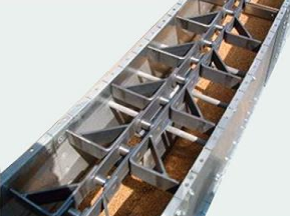
Application of belt conveyors: 1. Convey great variety of unit loads & bulk loads 2. Foundry shop to convey mold or sand 3. Deliver fuel in power plant 4. Distribution of molding sand 5. Coal or ores mining 6. Cement & food industries 7. Carry articles of light weight in line production from one operation to another. Advantages of belt conveyors: 1. High capacity 500-5000 m3 /hour or more 2. Ability to transport loads for long distance (500-1000m or up) 3. Simplicity in design 4. Comparatively low in own weight 5. Reliable source 6. Convenient operation 7. Less skill required to operate Disadvantages of belt conveyors: 1. Not suitable for hot ashes & slag. 2. Not suitable granular, powder 3. Abrasive material can cause defect in conveyor Flight Conveyor Ordinary solid flight conveyors consists of essentially of open trough secured on frame work, along with runs the putting member fitted the terminal sprockets & pulleys and takes its motion from drive unit & it initially tensioned by take up.
Working Principle 1. The material to be conveyed is loaded into the through at any point along the carrying run & is pushed by the flights. 2. Discharge can be effected at any point through openings in the trough, shut with gates or sliding doors. 3. Both the lower and upper strands of the conveyor can served as loaded stands. 4. When necessary it can convey materials simultaneously in opposite direction. Application 1. Convey various powdered, granular & free flowing lump materials. 2. Mostly using coal mining operations. 3. Transport hot ashes & slug. 4. Special cable-disk conveyors are employed for handling piece goods such as wood, pulpwood etc. Advantages 1. Simple design 2. Ability to convey in both direction. 3. Easy loading & unloading at any point along the conveying run. Disadvantages 1. Crushing & breaking of the materials during transportation 2. Rapid wear of trough & moving parts. 3. Can not transport load for long distance(50-60m) 4. Low capacity & it is (150-200) tons per hour. Different Parts of Flight of Conveyors Trough: The Trough is a welded structure made of 4-6 mm sheet steel of rectangular or trapezoidal or of rolled profiles.  Troughs may be stumped of sheet steel.  In conveyors designed to handle light-weight materials (such as sawdust, grail etc ). The trough may be of wood.  The clearance between flight & trough should be (3-6) mm.  The trough is assembled of 4-6 m long sections. Drive Unit: The drive unit is of the usual type, commonly supplied with a reducing gear.  It’s duty to protect gear against breakages in case of an accidental overloads Take Up Unit: The take up chain & flight conveyors is of the screw or spring and screw type.  The adjustment length should be nit less than 1.6 times the chain pitch. Frame Work: The frame work of flight conveyors is generally welded of rolled profiles & assembled of separate sections. Flights: Flat rectangular flight symmetrically fastened on roller chains to carry the flights have found the most extensive application.  Are one of the most frequently used types is the box-type flight conveyor with having longitudinal slide plates. Pulling Member: The reliable and effective operation & long service life of a conveying machine will be ensured if the pulling member wraps freely around drums, sprockets & pulleys of small diameter.  Combines high strength & low weight.  The conveying machine without a pulling member will not fit into general classification as they have no identical purpose. Difference between belt conveyor & flight conveyor Belt Conveyor 1. Can not transport hot ashes & slag. 2. Ability to convey in one direction. 3. Loading and unloading takes place at the specified position/fixed point. 4. Can transport load for long distance (500-1000m or more) 5. High capacity. 6. Comparatively low in own weight. 7. Less skill required to operate Flight Conveyor 1. Can transport hot ashes & slag 2. Ability to convey in both direction. 3. Easy loading & unloading at any point 4. Can not transport load for long distance (50-60m) 5. Low capacity (150-200 tons per hour). 6. Comparatively high in own weight. 7. Comparatively skill required.

Steam Generator

 A steam generator is a device used to produce steam by applying heat energy to water. Steam is widely used in industrial processes, power ...